
• Skip to primary navigation
  • Skip to main content
  • Skip to footer
  • Home
  • About
  • Book Appointment
  • Blog
  • Reviews
  • Contact me
Team Title Guy logo

Team Title Guy

Sell... Buy... Refi... Specify Team Title Guy!

  • YouTube Videos
    • YouTube Channel
    • Educational Minute
    • Ryan’s Rants
    • TTG Events
    • Rancho Cucamonga
    • Training Classes
    • City Programs
    • Real Estate Closings
  • Podcast
  • RE Market Update
  • Event Calendar
  • Title Resources
    • Forms and Documents
    • Informational Flyers
    • Transfer Tax and City Tax
    • Legal Documents
    • Fidelity Fee Schedule
    • Order CPL
    • Fidelity Agent
    • FNT Utilities
    • Comps

Team Title Guy Blog

Should You Wait Until After the Holidays to Buy or Sell?

Listen to this Market Minute episode

Most people hit pause on real estate between Thanksgiving and New Year’s. That might be the biggest mistake of the season.

I sat down this week with mortgage pro Matt Lewis of Arbor Financial Group to take on the three questions buyers, sellers, and agents are searching right now:

  1. Should I wait until after the holidays for rates to drop?
  2. Is buying over the holidays actually smart?
  3. Should I keep my listing up through the holidays, or pull it until spring?

Matt’s short version is not “wait and see.” If you can afford the home at today’s price and payment, this is a moment with fewer people shopping — and the buyers who are out are usually serious.

Where rates actually are

Matt’s snapshot on the call: the 30-year fixed hit an October peak around 7.4%. As of Tuesday, the national average was running about 7.3%. The next day’s PCE report, the Fed’s preferred inflation measure, was still ahead.

So the first instinct a lot of people have is to wait for a 6 in front of the rate. Matt does not think that is a great plan.

The first question he asks a buyer is simpler: are you financially comfortable with the payment at this price? If the answer is yes, the rest of the market starts to work in your favor. Rates in the 7s have kept a lot of people on the sidelines. “If we just wait for a rate until we have a six in the front,” he said, “that’s just going to bring more competition into the mix. And now that might even push prices up.”

His line on the holidays was pretty direct: “I think it’s a fantastic time to buy and have more leverage as a buyer.”

Waiting has a cost, even if rates come down later

There is another piece people skip when they are staring at the rate.

Even if rates drop later, prices may not sit still. If you wait a year or two and the home keeps appreciating, you can end up paying more, not less. And if you are renting in the meantime, you are already paying a mortgage. You are just paying someone else’s.

That is why I tell people to look at real numbers on a real property, not a headline rate they hope shows up after New Year’s. Waiting only for a lower rate is not a strategy. Knowing whether you can afford the payment today is.

Buying over the holidays is almost like a gift

That was Matt’s phrase, and I think it is the right way to frame it.

Sellers who are listed between Thanksgiving and New Year’s are usually serious. They often have a reason they need to move, even when other people would rather be hosting dinner than hosting a showing. That can open the door to a conversation about price, closing costs, or a rate buydown.

“These sellers are serious,” Matt said. “So I feel like it gives people a bit more opportunity to maybe ask for those things.”

If you can afford the home at today’s rate and price, this is a great time to ask.

What the local numbers are actually doing

This is not a national story with a local name taped on it.

In Rancho Cucamonga, single-family inventory was at 162 on the call, down from the 180s and 190s we had been hovering around. That kind of drop is pretty common this time of year, because fewer people want to list over the holidays. What stood out more was the share of listings taking a price reduction: 47%. That is a big jump from the high 20s and low 30s we had been seeing for a while.

Upland looked a little different. Inventory was actually up, and price reductions were at 35%. Days on market were running about a month, and closer to two months at the top of the market. Fontana was more of the same as the last 90 days: a modest inventory change and about a month of days on market, two months at the very top.

Nationally, inventory is down. The median list price Matt and I compared was about $425,000 across the country versus about $933,000 in Rancho Cucamonga. National median days on market was 77. Most of our areas, except the highest price points, were running at about half to three-quarters of that. About 43% of listings nationally were taking a price cut — so Rancho’s 47% is high, but it is not happening in a vacuum.

One more thing I am seeing in our own files: it is taking more than one escrow to get a transaction closed more often than I can remember. People are falling out at a higher rate. Matt is also seeing rescue work on the lending side, and a lot of it comes back to communication — keeping clients informed on rates and locking in a volatile market.

If you are an agent, this is why staying current on your farm still matters. You cannot negotiate well if you do not know what is actually happening in that zip code.

A $17,000 seller credit can do very different things

Builders have been using incentives to move inventory for a long time. Matt is seeing more traditional resale sellers do the same thing when a home is taking longer to sell.

He walked through one example on a $900,000 purchase, 20% down, at 7.34%:

  • With no credit, the payment is about $6,100 a month.
  • If the seller cuts the price by $17,000, that saves about $116 a month.
  • If that same $17,000 goes toward a 2-1 buydown, year one is 5.34% and the payment drops to $5,171 — about $940 a month less in year one. Year two would be 6.34%, then it settles back in the 7s.
  • If that $17,000 is used for a permanent buydown, to roughly 6 7/8%, the savings is about $226 a month.

Which one makes sense depends on the buyer’s time horizon and their view of where rates are headed. A temporary buydown gives more relief up front. A permanent buydown is the more conservative, lasting change. A price cut helps, but in this example it moved the payment a lot less than using the credit on the rate.

This is general information, not a quote and not a commitment to lend. The right structure has to be run for that buyer, that property, and that seller.

And no, waiting for rates to go back to 3% is not a plan. Unless you are looking at a builder who is buying the rate down in a big way, that is not the market we are in.

Keep the listing up

So should you pull the listing until spring?

I would think hard before you do that. Buyers who are out looking at Christmas are usually serious buyers. You are going to get serious offers from people who actually want to close. If you take it off and wait, nobody really knows what rates will do between now and then. If they drop, you may also be competing with a wave of sellers who have been holding back for the same reason.

It still comes down to why you listed in the first place, whether the home is priced correctly, and whether you have clear expectations. Those things do not get easier just because you waited for a nicer month on the calendar.

Listen, then get real numbers

The full conversation is up now, including year-end marketing tools, a mid-show rate check, and some of the ways agents can do more with less heading into the first quarter.

Listen to the episode here

Join us live next Tuesday at 9:30 AM PT on Zoom: https://us02web.zoom.us/j/81445717277

Want help thinking this through for a specific property or a specific client? Call or text Ryan J Orr at 909-447-9266. Rates, programs, and examples discussed are for general information only and are not a commitment to lend. Talk with a licensed loan officer about your situation.
After the Discharge: Judgment Liens, Homestead Exemptions, and Selling During Bankruptcy, with Derek May

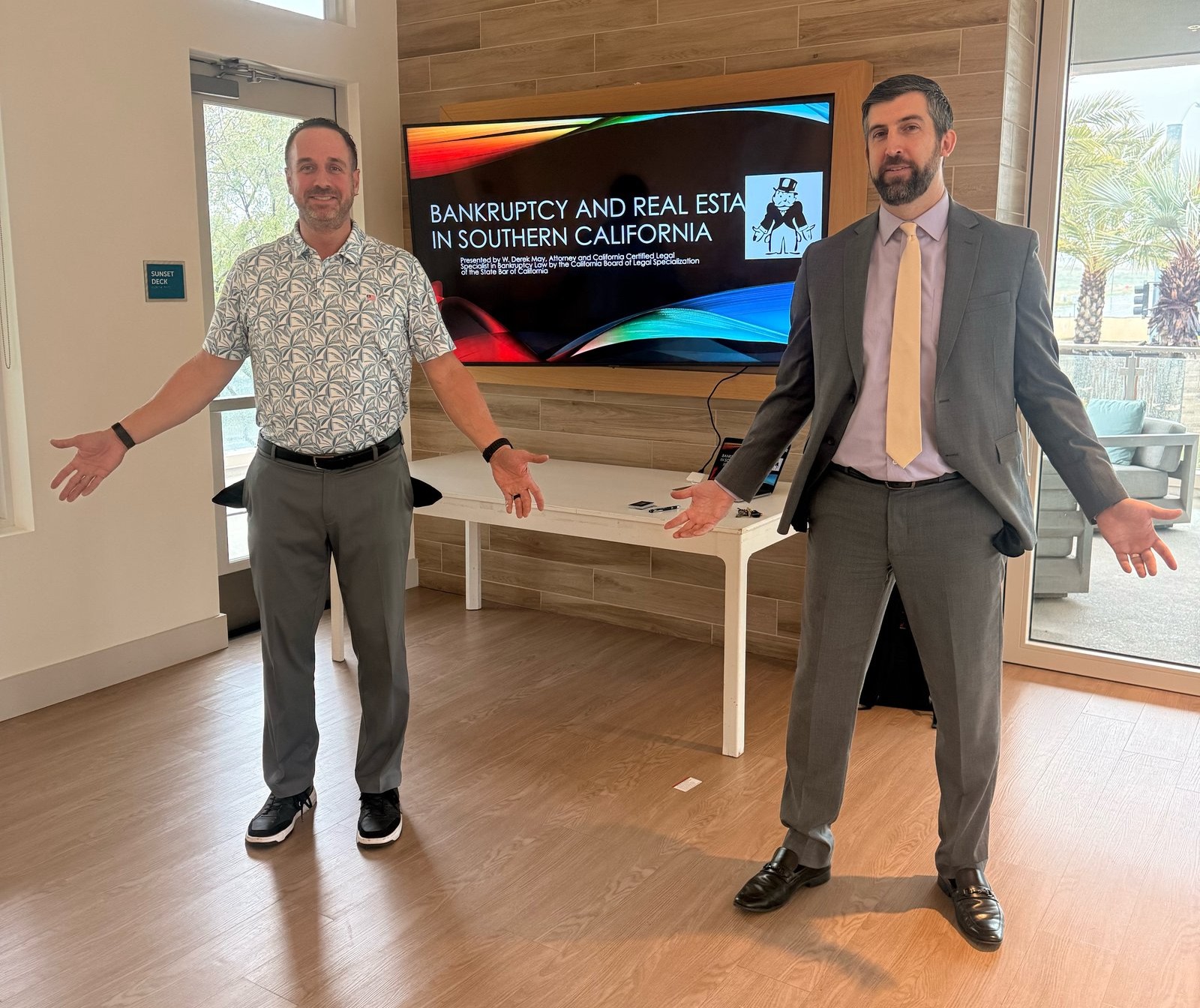
Ryan J Orr and bankruptcy attorney Derek May at Meetings with Masters on November 19, 2026, in Rancho Cucamonga
Ryan J Orr and bankruptcy attorney Derek May at Meetings with Masters on November 19, 2026, in Rancho Cucamonga, in front of Derek’s “Bankruptcy and Real Estate in Southern California” slide.

The fear I hear most often is some version of this: if you file bankruptcy, you will never own a home again — and anything still sitting on title is automatically gone once the discharge arrives.

Neither is true.

Bankruptcy attorney Derek May joined me at Meetings with Masters on November 19, 2026, in Rancho Cucamonga. He is a California certified legal specialist in bankruptcy law and, as he told the room, likely the only certified specialist in San Bernardino County. He has been practicing bankruptcy for 20 years as of December 2026. What followed was a working session on how consumer bankruptcy actually intersects with a house: the automatic stay, Chapter 7 versus Chapter 13, California’s homestead exemption, why a discharge can still leave judgment liens on title, and what it takes to sell during an open case.

This is the companion to that conversation, drawn from Derek’s slides and the discussion in the room.

Who is calling a bankruptcy attorney right now

Derek has been filing more Chapter 13s to stop foreclosures. Over the summer, he said, he was averaging four or five of those a month. From 2020 to 2022, he had only two or three for that entire stretch.

The calls are not only coming from people who lost a job. A very common story is the household that bought recently, already stretched on the housing payment, and then lost overtime they were counting on. “Anything that happens, it kind of tips it over, and a lot of those people start relying on credit cards to bridge the gap.” Extra cards start covering the minimums on the other cards, “and it snowballs quickly.”

It is not only lower-income households. One couple he described made about $500,000 a year and had about $500,000 in unsecured debt. Their minimum payments were $18,000 a month. Because of debt limits, he could only file for one of them — student loans would have put a joint filing over the cap — and the husband’s Chapter 13 payment dropped to $9,000 a month over five years, with no interest. Then two or three more files like that walked in. “It’s kind of a trend, and these are folks with high income but high expenses.”

For agents, the useful question is not only who is ready to buy or sell. It is also who you know that is stretched right now. That pressure can land on a marriage as much as on a mortgage.

The automatic stay is powerful — if the trustee is actually notified

“The main kind of power that I have as a bankruptcy attorney is the automatic stay,” Derek said. It is created by federal statute, 11 U.S.C. § 362. On a first filing, it is generally triggered the moment the case is filed. It stays collection, repossession, and foreclosure.

Timing still matters. “As long as the bankruptcy is filed before the foreclosure sale takes place, you’re going to stop that sale.” The other half of that sentence is notice. The foreclosure trustee has to know about the filing. The notice of trustee’s sale has a sale number, a phone number, and often a website. Call a person, not only an automated line, and ask exactly where to send the documentation. Derek’s worst-case backup is sending his assistant to the sale itself, or at least creating a record of a fax to the trustee. A stay on paper does not help much if the sale happens because no one was told.

A discharge is the other main reason people file. In a Chapter 7, that typically comes in about four months. In a Chapter 13, it comes after the plan payments are completed — usually three to five years. Derek was careful about the word “wipe out.” “Your debts are still there. You just have legal excuses not to pay them anymore.” That legal excuse is enforced by a discharge injunction, and it does not create the kind of cancellation-of-debt income you can see when you settle a bill outside of bankruptcy.

Not every debt is excused. His usual list included most recent income taxes, sales taxes, and payroll or other “trust taxes” withheld and never turned over — those last ones, he said, are never dischargeable. Student loans come off only if the court finds undue hardship, “a very tough standard to meet.” Ongoing HOA fees keep accruing if you still own the property after the filing. Fraud or willful and malicious conduct is not excused either. “It’s for honest folks, not fraudsters.”

Chapter 7 and Chapter 13 are different tools

Individuals and businesses can file a Chapter 7, but only individuals get a discharge. The debtor’s property becomes property of the bankruptcy estate, and a trustee looks for assets that can be sold to pay creditors. In practice, Derek said, “the vast majority of my cases are no asset cases.” California exemptions, especially the homestead, protect enough value that most people keep their property and discharge the personal liability. That is the “fresh start”: you are not supposed to start over with nothing.

A Chapter 7 can also buy time on a house you cannot keep — often two or three months to arrange a rental or try to sell before the foreclosure starts again. Once the case is over, or the lender gets relief from the stay, the foreclosure can proceed. “The way to save the house and save your equity,” Derek said, “is definitely Chapter 13.”

Chapter 13 is only available to individuals, including self-employed people and realtors filing personally. Instead of a liquidation, the debtor pays disposable income — take-home pay minus reasonable and necessary living expenses — to creditors over 36 to 60 months. Derek flagged an outdated line on his own slide: the CARES Act allowed seven-year plans during COVID. “That was true in COVID times, not anymore.” The maximum is five years.

Plan length depends on whether the household is above or below median income for its size. For a household of one, he used $79,000 as the current median. Below that, a three-year plan is available; above it, the lookback is six months of income, annualized. Even someone who qualifies for 36 months will often stretch mortgage arrears over 60 so the catch-up is actually payable. For commission income, the same six-month lookback applies, and plans can be modified later if income changes.

A Chapter 13 filed mainly to close a sale can be dismissed if that is how the file unfolds. Derek was candid that the U.S. Trustee’s office does not love filings that were never meant to go the distance, and he only does that in the right situation. He also measures success differently than a judge might. A dismissed 13 that still closed the sale is, to him, a success. Of his own Chapter 13s, he estimated maybe one in five go all the way through — and many of the others still did the job, such as catching the mortgage up.

People still tell him that a filing means they will never own a home again. “That’s not true.” His slide listed typical waiting periods for a conventional mortgage of four years after a Chapter 7 and two years after a Chapter 13, and he noted that FHA can be in the neighborhood of two years. Those are general guidelines from the conversation, not a promise about any one loan program.

Filings are up, but not back to pre-COVID

Derek’s “2026 bankruptcy filings through August” slide was for the Central District of California, which covers Los Angeles, Santa Ana, San Bernardino, and Riverside. Through August, the district had 22,471 total cases, up 15.3% from the prior year’s total.

Chapter 7Chapter 11Chapter 12Chapter 13Grand total
Opened18,62632113,15922,107
Reopened30520039364
Total18,93134113,19822,471
% change from previous year’s total14.8%25.8%0.0%17.8%15.3%

Chapter 7 still makes up the large majority. Chapter 13s are rising faster year over year, which lines up with Derek’s practice, even though he still does far more 7s — on the order of ten Chapter 7s for every Chapter 13. Filings have been creeping up since the historically low COVID years, he said, but they still have not reached 2019 levels. One reason the dip lasted, in his view: fewer creditor lawsuits for a while, because “people thought it was a bad look to sue people during COVID.”

The homestead exemption, and why the county matters

The largest exemption most Californians can claim in bankruptcy is on a primary residence. Derek’s 2026 figures:

  • Floor: $371,841 in home equity coverage
  • Statutory cap: $743,681
  • Los Angeles and Orange Counties: at the cap
  • Riverside County: $590,000
  • San Bernardino County: $497,000

Those county numbers are adjusted each year from the prior year’s median home price. The January 1 figure is not always final, because the data can lag; Derek said a solid number is usually in place around March.

To claim the exemption in bankruptcy, you do not need a recorded homestead. That is the automatic homestead. A recorded homestead can still help, he said, because it creates a presumption about which property is the homestead — useful if someone owns more than one place. It is for a primary residence, not a rental.

The exemption is not a force field in every situation. If there is substantially more equity than the exemption covers — Derek’s example was $700,000 in equity against a $497,000 exemption — a judgment creditor can try to force a sale. The homeowner would still receive the exempt amount toward another residence; the creditor would take the surplus. The creditors who actually try this, he said, are usually judgment creditors, not the IRS or the state.

He had a client with a 15-year-old deficiency judgment from a car the client had co-signed for a nephew. A small balance had grown into a $70,000 judgment, there was enough equity, and a sale was coming. Bankruptcy was not the right move because of that equity. The client ended up taking a home equity line to pay it. The surprise, Derek said, is how many people do not realize a creditor can sue, take a judgment, lien the house, and garnish wages. They thought nonpayment was “just bad for my credit score.”

Legitimate second and third mortgages are not part of the homestead math. What gets people in trouble is bad pre-bankruptcy “advice” to place a friendly insider lien on the house. If there was no real loan behind it, a trustee can attack that transfer, and the exemption may not be there to save the equity.

One more asset people should not raid first: a qualified retirement account. “I’ll bring this up because this is another kind of sad thing that I see: people will use their retirement and spend it all to make the minimum payments on their debt.” Under California law, a qualified IRA or employer 401(k) can be protected 100%. “If you had a million dollars in your retirement account, you can file for bankruptcy, get a discharge, and still have that for when you retire.” A regular brokerage account is not the same thing, and moving a bank balance into a retirement account on the eve of filing is not either.

The judgment lien that shows up in escrow

This is the part that blows up closings.

A bankruptcy discharge can excuse the personal liability on a debt and still leave a judgment lien sitting against the property. From the title side, that split is everything. When we run a prelim, we are looking at what is attached to the property. A statement of information is what helps us match judgments that came in against a name or Social Security number — or against an entity — to the people who actually own the home. The discharge papers matter. So does a recorded order avoiding the lien. A discharge letter by itself is often not enough.

Derek asks every client about judgments and lawsuits, and he treats lien avoidance as a separate, extra fee, not something automatically bundled into the flat fee for the case. In 2009 and 2010, with so many houses underwater, a lot of people got the discharge and simply left the liens in place. They were not sure they would keep the house.

Those liens can still be addressed later. “We can reopen the case and get an order voiding the lien later. It’s based on the value of the property at the time you filed the bankruptcy.” That is why a historical appraisal is part of the package. Maybe there is a great deal of equity now. If there was not enough equity then, the lien can still be avoided because it impairs the homestead exemption under section 522(f) of the Bankruptcy Code. Derek has gone back as far as ten years. He also had a client this year with eight judgments — about $600,000 in debt — and removed all eight.

Once he has the documents, “it takes about 30 days.” It is not an emergency in the court’s eyes that a ten-year-old judgment is in the way of a closing next week. If a sale is already in escrow, build in that time. Do not assume the original attorney finished this step.

What you generally cannot do later is strip a voluntary second mortgage the same way. That tool is narrower: in a Chapter 13, and only if the junior deed of trust was fully unsecured at filing. Derek did “a ton of those” in 2009 and 2010. “I don’t think I’ve done one for a long time now.”

Judgments also have a life cycle. In California they are typically valid for ten years and can be renewed. Derek noted that a creditor can renew a judgment after a bankruptcy filing to preserve the lien, and that renewal is not a violation of the discharge. If the lien was never avoided, time and a missed renewal are not a plan. Getting the 522(f) order is.

Selling a house while a bankruptcy is open

Yes, a realtor can close a transaction during an active bankruptcy. “They have to get approval of the bankruptcy court.”

It is much harder in a Chapter 7. Derek usually tells clients to wait until the case is over, “because it’s only four months.” To sell during a Chapter 7, the trustee has to abandon the property so it is no longer property of the estate. That is where title and the bankruptcy process can talk past each other. Once the property is abandoned, the court may no longer have jurisdiction to enter the kind of sale-approval order a title company wants to see. “What the title wants, we can’t really give them. That’s the issue.” From the title side, we want a clear court order and a clear map for the proceeds before anyone marks a file as ready to close.

If there is substantial exempt equity and substantial unsecured debt, Derek’s first instinct is often not “just list it and pay everyone.” If the client qualifies for Chapter 7, “it makes much more sense to file for bankruptcy in that situation.” Selling and writing checks to unsecured creditors can leave the household with less than the exemption would have preserved. Exempt proceeds can also be reinvested in another, perhaps more affordable, property within six months, and still kept as exempt.

Another clock: California’s listing-based foreclosure postponement

Bankruptcy is not the only way to buy time to sell. Assembly Bill 2424, codified in California Civil Code § 2924f, lets a homeowner postpone a foreclosure sale with a valid listing, without filing a case.

The requirements are specific:

  • Deliver a listing agreement with a California-licensed real estate broker to the foreclosure trustee at least five business days before the scheduled sale. The day before will not work.
  • Send it by certified mail or overnight courier with tracking and a signature.
  • If those requirements are met, the trustee must postpone the sale for 45 days.
  • If you then get a buyer, deliver a fully executed purchase agreement at least five business days before the rescheduled sale and you get another 45 days to close escrow.

“This is not bankruptcy involved. This is just outside of bankruptcy under California law.” Derek’s comparison was honest: “I would say it’s not as strong as a bankruptcy stay, but it is California law.” If a trustee does not follow it, the likely remedy is a wrongful-foreclosure action. A stay violation, by contrast, can go straight to a bankruptcy judge, who can reverse the sale quickly.

That is why the listing statute is a planning tool, not a last-afternoon Hail Mary, and why a bankruptcy filing is sometimes still the only option if the notice window is already gone. In the right file, the two can also work together. We recently had a matter where a foreclosure was days away, a bona fide cash offer went in, money was deposited in escrow, and the sale was stopped. There was also an active bankruptcy, and the court documentation took most of a month. We closed shortly after it arrived.

Why this belongs in the conversation before the prelim comes back

Derek’s practical uses for bankruptcy in a real estate file are straightforward. A Chapter 7 can stop a foreclosure and keep someone in the house for a short window. A Chapter 13 can stop the sale and pay the arrears. Judgment liens can be removed, often years after a case is closed, if the case is reopened and the motion is actually filed. A filing can buy time to sell and preserve equity. Over a longer horizon, clearing unsecured debt can also repair a debt-to-income ratio enough to qualify for a loan again after the waiting period.

The missed step is almost always the one that looks optional on the front end and immovable a week before closing: the lien that was never avoided, the trustee who was never notified, the homestead or retirement account that was never explained, or the sale that needed court approval and did not have it.

If you have a client — or a property — in this situation, call or text Ryan J Orr at 909-447-9266. I can help you think through the title and escrow side with Team Title Guy at Fidelity National Title, including when a deeper look at the public record is worth it, and I can point you to a bankruptcy attorney who actually does this work.

Listen to the full conversation here: After the Discharge: Judgment Liens, Homestead Exemptions, and Selling During Bankruptcy, with Derek May

General information only, not legal, tax, or lending advice. Talk with a bankruptcy attorney and, when a loan is part of the plan, a licensed loan officer about your specific facts. Waiting periods, exemption amounts, and filing figures are as Derek presented them on November 19, 2026, and can change.

California SB 255: How Recording Notices Help Protect Property Owners

Quick answer: California’s SB 255 added Government Code section 27297.7. The law took effect January 1, 2026, and counties have until January 1, 2027 to set up recording notification programs and adopt authorizing resolutions. After a deed, quitclaim deed, mortgage or deed of trust is recorded, the county recorder mails a notice within 30 days to the parties who signed it, using the property-tax mailing address that was on file before the recording. The notice can help owners spot a recording they did not expect, but it arrives after the document is already on the record. It does not prevent fraud, reverse a document or replace title insurance.

If you close homes in the Inland Empire, your clients may start seeing a letter from the county recorder after a deed or loan document is recorded. Riverside County owners may already recognize the idea: that county has mailed Courtesy Notices for years. SB 255 makes a recording-notification program a statewide requirement, with a county deadline of January 1, 2027.

Here’s what the law actually requires, what the notice can and cannot do, and what I would tell a client who gets one.

What is California SB 255?

Senate Bill 255, signed in October 2025, repealed and replaced California Government Code section 27297.7. The new section took effect January 1, 2026. On or before January 1, 2027, each county must establish a recorder notification program and the board of supervisors must adopt an authorizing resolution.

Statutory exceptions apply. Los Angeles County’s separate program under Government Code section 27297.6 is one of them. The notice requirement also does not apply when the federal government, or a state, county, city or other state subdivision, is the grantee on the recorded document. Counties may charge a recording fee to cover the reasonable cost of the program, but only after at least 120 days of public notice.

There is no statewide sign-up portal. Each county runs its own program, so timing and extras can vary. Some counties may start mailing before the deadline; others will need the full time to get set up.

How the notice works

  1. A document is recorded. A deed, quitclaim deed, mortgage or deed of trust is recorded with the county.
  2. A notice is mailed. Within 30 days, the county recorder mails notice to the party or parties identified as signing the document. It goes to the address used for mailing property-tax bills that was in place before the document was recorded.
  3. The owner reviews it. Check the notice. If the recording is one you already know about, such as a recent closing or refinance, keep the letter with your closing papers. If you do not recognize the document, look into it promptly.

In addition to the mailed notice, a county recorder may offer optional electronic alerts. Those are allowed, not required, so ask your local recorder what is available.

A simple example

Someone records a forged deed claiming an owner transferred their home. The owner may not discover that on their own for a long time. A recording notice, mailed to the prior property-tax address, can alert the owner to investigate the recording and get help sooner.

What property owners should do

  • Keep your property-tax mailing address current. The notice is sent to the tax-bill address that was on file before the recording. If that address is old, the letter may never reach you.
  • Review every notice, even after a legitimate closing. A letter after a sale, purchase or refinance is often expected. Still read it and confirm it matches the transaction you authorized.
  • Ask the recorder about optional electronic alerts. If your county offers email or other electronic notices, they can be a useful backup to the mailed letter.
  • If a document looks unfamiliar, get a copy from the recorder. Suspected fraud warrants prompt help from an attorney and law enforcement. If you have an owner’s title insurance policy, contact your title company as well.

What the notice does not do

This part matters as much as the rest. The notice comes after recording. It does not prevent a fraudulent document from being recorded, it does not reverse or cancel a document, and it does not replace title insurance.

Think of it as an early warning, not a lock on the front door. Title insurance, careful identity checks at closing, and paying attention to unexpected letters still all have a job to do.

Inland Empire resources

Riverside County already mails Courtesy Notices when a deed, deed of trust or similar document is recorded, a program the Assessor-County Clerk-Recorder says began September 1, 2011. If you recognize the transaction, no further action is usually needed. If you do not, the county directs property owners to the District Attorney’s Real Estate Fraud Unit. Details are on the county’s Real Estate Fraud page. The District Attorney’s fraud hotline listed there is (877) 723-7779.

San Bernardino County: I did not find a current official Assessor-Recorder-County Clerk page that describes an SB 255 program or a recording-notification signup. To obtain a copy of a recorded document, use the county’s Official Records page or contact the Assessor-Recorder-County Clerk at (909) 387-8306. Ask the recorder what notices, if any, are being mailed now and whether optional electronic alerts are available.

The California Department of Real Estate also keeps a list of county notification services it knows about. Riverside County appears there under letter notifications. That list may not include every county, so it is still worth asking your local recorder directly.

Learn more

  • SB 255 bill text at the California Legislature
  • Government Code section 27297.7, the current statute
  • Fidelity National Title’s one-page overview, California SB 255 (PDF, current as of October 7, 2026)
  • Fidelity National Title’s consumer flyer, Protecting Property Owners: SB 255 (PDF)

A few common questions

When do the notices start?

The law is in effect now, and counties must have their programs in place on or before January 1, 2027. A county starts mailing after its board of supervisors adopts the authorizing resolution and the program is up and running. Ask your county recorder for the current status.

Which documents trigger a notice?

The statute covers a deed, quitclaim deed, mortgage or deed of trust. Other recorded documents may not trigger this particular notice.

Does getting a notice mean something is wrong?

No. Notices go out after covered recordings, including ordinary, legitimate closings. The point is to give the people who signed the document a chance to confirm it.

Does this replace title insurance?

No. The notice is a heads-up after a recording. It does not prevent fraud, undo a document or take the place of an owner’s title insurance policy.

This post is general education, not legal advice. Requirements and exceptions can vary by county and by document. For a specific situation, consult the official law, your county recorder and a qualified attorney.

I’m Ryan J Orr, VP with Fidelity National Title in Rancho Cucamonga. If you want to walk through a recording notice with a client, or you have a question about title coverage after an unexpected recording, call or text me at 909-447-9266, book a 30-minute call, or visit my agent tools at fidelityagent.com/ryanorr.

What to Look for in a Title Company: A Guide for Inland Empire Buyers, Sellers and Agents

Quick answer: What to look for in a title company? Start with three things: experience, reputation and reliability. In California, also make sure the company is licensed by the California Department of Insurance, ask how it protects your money from wire fraud, compare its filed rates and discounts, and pick a team that answers the phone and knows your local market. The person paying for the title policy gets to choose the company.

Buying or selling a home is one of the biggest financial moves most people ever make, and title insurance is a big part of what protects it. But a lot of buyers and sellers never think about which title company is on their deal until something goes sideways. After 24+ years working with real estate agents here in the Inland Empire, I can tell you the right title company is the one you barely notice, because everything just closes on time.

Here’s what to look for, the questions to ask, and how it works here in Southern California.

What does a title company do?

Before it issues a policy, a title company searches public records and its own property databases (called title plants) for deeds, loans, liens, judgments, tax records and other items tied to the property. You get the results in a preliminary title report. The California Department of Insurance (CDI) explains that title insurance then protects you or your lender against covered losses from title defects that existed before you bought the home, such as forgeries, unknown liens, missing heirs or errors in public records. You can read the full breakdown in the CDI Title Insurance Guide.

Unlike homeowner’s insurance, title insurance is a one-time premium paid at the close of escrow.

Owner’s policy vs. lender’s policy

There are two common policies:

  • Lender’s policy: most lenders require it, and it protects the amount they lend. It does not protect you.
  • Owner’s policy: protects you, the buyer, for as long as you own the home, if someone later makes a covered claim against the property from before you bought it.

The Consumer Financial Protection Bureau notes that buying both from the same provider usually costs less than buying them separately.

What to look for in a title company

Fidelity National Title’s November newsletter boils it down to three things: experience, reputation and reliability. Here’s how I’d unpack each one, plus a few California-specific checks.

1. Experience

Title problems are rarely obvious. Probate sales, trust transfers, divorces, old easements, unpaid tax liens and boundary questions all take an experienced title officer to sort out quickly. Ask how long the team has been doing this and how often they handle deals like yours.

2. Reputation

Ask your agent and lender who they trust and why. Read reviews. A company with a good reputation among local agents is usually one that solves problems early instead of at the last minute.

3. Reliability

Reliable means the preliminary report shows up fast, questions get answered the same day, and documents are ready when it’s time to sign. Ask who your point of contact will be and how quickly they typically respond.

4. A license and a strong underwriter

In California, a title insurer must hold a certificate of authority from CDI, and underwritten title companies must be licensed by CDI. Title sales reps must be registered with CDI, too. You can check a company’s license on the CDI website. Ask which underwriter stands behind the policy.

5. Local knowledge

CDI notes that title and escrow practices and prices vary from county to county, so local experience matters. A team that works the Inland Empire every day knows San Bernardino and Riverside County recording schedules, holiday closures and the quirks of local tracts.

6. Wire fraud protection

Closing scams are real. The CFPB’s mortgage closing scam tips say to never trust wiring instructions sent by email, to confirm instructions by calling a phone number you already know is real, and to be extra careful with last-minute changes. Ask your title and escrow team how they verify wiring instructions. If something feels off, stop and call.

7. Clear, competitive rates

Under California law, every title insurer and underwritten title company must file its rates with the Insurance Commissioner, and CDI says rates can differ between companies. Ask about available discounts. CDI lists examples such as refinance, short-term resale, concurrent owner’s and lender’s policies, and first-time buyer discounts, depending on the company.

Questions to ask a title company

  • How long have you been handling title in the Inland Empire?
  • Who is my point of contact, and how do I reach them?
  • How fast can I expect the preliminary title report?
  • Which underwriter issues the policy?
  • How do you protect my funds from wire fraud?
  • What discounts might apply to my transaction?
  • What tools do you offer agents and clients, like property profiles?

Who chooses the title company in Southern California?

According to CDI, the choice belongs to whoever pays for the policy. In Southern California, the seller customarily pays for the owner’s title policy, while in almost every county the buyer pays for the lender’s policy, though the parties can negotiate. CDI also notes that federal law (RESPA) prohibits a seller from requiring a buyer to purchase title insurance from a particular company. And here in Southern California, title and escrow are usually separate services, so you may work with one company for title and another for escrow.

Want to see it in under a minute? Fidelity National Title has a short video on what to look for in a title company.

This post is general education, not legal or tax advice. Every transaction is different, so talk with your agent, escrow officer or attorney about your situation.

Talk to your Title Guy

I’m Ryan J. Orr, VP with Fidelity National Title in Rancho Cucamonga. Whether you’re an agent picking a title partner, or a buyer or seller who wants to understand the process, I’m happy to help. Call or text me at 909-447-9266, book a 30-minute call, or check out my agent tools at fidelityagent.com/ryanorr.

How to Move Your Farm into FNT Property Pro in 4 Easy Steps

Quick answer: The new FNT Property Pro farm import lets you bring an existing farm over from the platform you use today in four steps: export your farm, sign in and upload the file, give the farm a name, and click Import. Property Pro recognizes the farm automatically, so there is no column mapping to fight with. If you can’t export your farm yourself, you can request a copy from the Customer Service team, or just call me and I’ll help.

If you’ve been farming the same Inland Empire neighborhoods for years, the last thing you want is to start over from a blank map. I hear it from agents all the time: “I’d try a new farming tool, but I’ve got years of work sitting in the old one.” Fidelity National Title heard the same thing, and the newest update to FNT Property Pro is built for exactly that problem. As the November Fidelity Insider put it, your farms travel well.

Here’s how the new farm import works, which platforms it supports, and a few tips I’d share with any agent in Rancho Cucamonga, Upland, Fontana, Ontario, Eastvale or anywhere else in the IE before you make the move.

What is FNT Property Pro?

FNT Property Pro is Fidelity National Title’s property data and farming platform for agents and teams. According to the Property Pro site, it gives you dynamic farming tools, ownership details such as how long an owner has held a property, filters that help you focus on likely sellers, and a live list builder that lets you export mailing labels or sync lists to your CRM.

In plain English: it helps you pick the right neighborhoods, understand who lives there, and stay in front of them consistently. That’s how you become the agent everyone in the tract knows by name.

Which farming platforms can you import from?

According to Fidelity National Title’s November newsletter, the new import supports farms exported from these platforms:

  • Active Farm
  • Total Farm
  • Live Farm
  • Dynamic Farm
  • Tech Farm
  • TP247
  • GPS
  • Title Toolbox

If your current tool isn’t on that list, don’t give up. Call me and we’ll figure out the best way to rebuild that farm in Property Pro.

How to import your farm into FNT Property Pro in 4 steps

This walk-through follows Fidelity National Title’s Move Your Farm flyer (PDF).

Step 1: Export your farm

Go into the farming platform you use today and export your farm as a file. If you’re not sure how to export it, or you’d rather not deal with it, you can request a copy from the Customer Service team instead.

Step 2: Import your file

Sign in to FNT Property Pro and upload the farm file you exported in step 1.

Step 3: Name your farm

Property Pro recognizes your farm automatically, so there’s no complicated data mapping. All you have to do is give the farm a name. My tip: use names you’ll recognize at a glance six months from now, like “Etiwanda North 2026” or “Upland Colonies,” instead of “Farm 1.”

Step 4: Complete your import

Click Import, and your farm is ready to use. That’s it.

What to do after your farm is in Property Pro

Getting the farm moved is step one. Here’s how I’d put it to work this month:

  • Check the boundaries. Pull up the map and make sure the farm covers the streets you actually work. Adjust it if your territory has grown.
  • Build a fresh list. Use the live list builder to pull a current mailing list instead of relying on a static list that may have gone stale.
  • Look at ownership and tenure. Long-time owners in a neighborhood can be great people to start a conversation with about their options.
  • Plan a November touch. The holidays are a natural reason to reach out. A short note, a market update or a local events list keeps you top of mind without a hard sell.
  • Stay consistent. Farming works because homeowners see your name again and again. Pick a rhythm you can keep and stick to it.

Why it matters for Inland Empire agents

Farming is a long game. The agents I’ve watched win in the Inland Empire over my 24+ years in this business are the ones who show up in the same neighborhoods month after month. Losing that history because you switched tools can set you back. The new import means your years of farming come with you, and you get Property Pro’s data on top of it.

FNT Property Pro features and supported platforms come from Fidelity National Title’s November 2026 newsletter, its Move Your Farm flyer and the FNT Property Pro website. Features can change, so check with me for the latest.

Need help moving your farm? Call your Title Guy

I’m Ryan J. Orr, VP with Fidelity National Title in Rancho Cucamonga. If you’d like a hand exporting your farm, getting set up in Property Pro, or planning your next mailing, call or text me at 909-447-9266, or book a quick 30-minute call on my calendar. You can also find my agent tools at fidelityagent.com/ryanorr.

What neighborhood are you farming this year? Tell me, and I’ll help you make it yours.

2027 TRID Calendar: When Can Your Buyer Sign? (Free PDF)

Every agent has had this happen: the Closing Disclosure goes out a day late and the signing you promised your clients moves. Under TRID, the CD has to reach the borrower three days before consummation. The 2027 TRID Calendar from Fidelity National Title lets you look up any date in 2027 and see the earliest signing date right away.

Download the free 2027 TRID Calendar (PDF)

What the TRID 3-day rule means for agents

Here’s the short version from the calendar’s own notes:

  • The period is counted in days, not hours. The calendar says the disclosure “must be delivered three days before closing, and not 72 hours prior to closing.”
  • Sundays and observed holidays don’t count. On the calendar they show up in red, with a dash where a signing date would be.
  • Delivery method matters. Hand delivery and mail delivery each get their own row, and the mail dates come later.
  • E-delivery is an option. Disclosures “may also be delivered electronically to start the Delivery Period and may be signed in compliance with E-Sign requirements.”

How to read the calendar

Each month has three rows:

  1. CD delivery date: the day the Closing Disclosure goes out.
  2. Signing Date (Hand): the earliest signing date if the CD was hand-delivered that day.
  3. Signing Date (Mail): the earliest signing date if the CD was mailed that day.

Find the delivery date in the top row and read straight down. Page 2 also has a reference by day of the week chart. A CD hand-delivered on Monday signs Thursday, Tuesday signs Friday, Wednesday signs Saturday, Thursday signs Monday, and Friday signs Tuesday. A mailed CD signs on the same weekday the following week. Sunday is never counted.

Worked examples (read straight off the 2027 calendar)

  • A normal week: a CD hand-delivered Wednesday, January 6, 2027 can sign on Saturday, January 9.
  • A holiday weekend: a CD hand-delivered Thursday, January 14, 2027 can’t sign until Tuesday, January 19. Sunday 1/17 and Martin Luther King Jr. Day (Monday 1/18) are both skipped. If that same CD is mailed on January 14, the earliest signing date is Friday, January 22.
  • Thanksgiving week: a CD hand-delivered Monday, November 22, 2027 can sign on Friday, November 26, because Thanksgiving (Thursday 11/25) doesn’t count. Mailed that same Monday, it signs on Tuesday, November 30.
  • Memorial Day: a CD hand-delivered Thursday, May 27, 2027 signs on Tuesday, June 1. Sunday 5/30 and Memorial Day (5/31) are skipped.

2027 dates that affect your signing date

According to the calendar, these 2027 dates push signing dates out:

Date Holiday
Jan 1 New Year’s Day
Jan 18 Martin Luther King Jr. Day
Feb 15 Presidents’ Day
May 31 Memorial Day
June 19 Juneteenth Independence Day
Jul 5 Independence Day (observed)
Sept 6 Labor Day
Oct 11 Columbus Day
Nov 11 Veterans Day
Nov 25 Thanksgiving Day
Dec 25 Christmas Day

The calendar also notes that Fidelity National Title is open for business on Columbus Day and Veterans Day and can sign eligible borrowers.

Get your copy

Print the calendar, keep it at your desk, and share it with your team and your lender partners. Download the 2027 TRID Calendar (PDF), or comment “TRID” on any of my posts and I’ll send it to you.

Do you have questions about a closing timeline, or want a stack of printed copies for your office? Contact Ryan J. Orr, VP at Fidelity National Title in Rancho Cucamonga, at TeamTitleGuy.com.


Disclaimer (paraphrased from the calendar): This calendar is general information to help real estate professionals estimate when a transaction with an applicable loan may consummate. It isn’t legal advice. The CFPB rule that sets these time periods also allows them to be shortened or extended in some situations. Every transaction is different, and the lender has the final say on the actual consummation date, so check with your escrow officer or loan officer for your transaction. The content is for informational purposes only and is considered reliable but not guaranteed.

  • Page 1
  • Page 2
  • Page 3
  • Interim pages omitted …
  • Page 61
  • Go to Next Page »

Footer

Follow Us

Copyright © 2026 · Ryan J. Orr · Fidelity National Title
Privacy | California Privacy | Terms of Use | Accessibility