• Skip to primary navigation
  • Skip to main content
  • Skip to footer
  • Home
  • About Team Title Guy
  • Book Appointment
  • Subscribe to Email
  • Contact me
Team Title Guy

Team Title Guy

Sell... Buy... Refi... Specify Team Title Guy!

  • YouTube Videos
    • YouTube Channel
    • Educational Minute
    • Ryan’s Rants
    • TTG Events
    • Rancho Cucamonga
    • Training Classes
    • City Programs
    • Real Estate Closings
  • Event Calendar
  • Market Update
  • Blog
  • Reviews
    • Yelp Reviews
  • Title Resources
    • Forms and Documents
    • Informational Flyers
    • Transfer Tax and City Tax
    • Legal Documents
    • Fidelity Fee Schedule
    • Order CPL
    • Fidelity Agent
    • FNT Utilities
    • Comps
  • Podcast

Market Report

Will the Real Estate Market Crash in 2019?

The COO of a tool I like to use for market reports and data, interviewed. He answers questions on the Real Estate Marketplace today, and his thoughts based on the data as to where we are headed based on the numbers

How’s the market? Altos CEO Mike Simonsen recently sat down with HomeSmart International’s Wendy Forsythe to share what the data is telling us about the coming year (hint: look for more inventory and less insanity!)

Watch the 10-minute interview here:

Your thoughts?

(disclaimer, this is a talk that was posted by a real estate blog, and I am not endorsing for or against the company that posted this. I liked the content.)


What even ARE Deferred Sales Trust and 1031 Exchange?

In this session of Meeting with the Masters we have Greg Burns of IPX1031, as well as Joel Harworth and Philip A. Board from 1 on 1 Financial here to discuss the ins and outs of 1031 Exchanges and Deferred Sales Trusts and how to use them to your advantage. If you prefer to listen to the recording of the episode, you can hear it HERE.  As always, you can listen to our podcasts on Itunes, Stitcher, or Spotify.

The Masters Team: Greg Burns, Philip A. Board, Ryan J. Orr, Joel Harworth, and Ron Romero

This discussion is going to be based upon the answers to the question what should you do with appreciated assets you want to cash in on?  The answers to this question are as follows:  Sell and pay the astronomical taxes on them, do a 1031 Exchange, do a Deferred Sales Trust, or just hold onto your assets.  We’ll be discussing everything about the middle two options because the others are self explanatory.

Click here to jump to Deferred Sales Trusts

Click here to jump to FAQ

Why Do a 1031 Exchange & What are the Limitations?:

  • 1031 tax code says that if you sell a property for investment or business use to exchange for another real estate property whose initial intent of purchase must be investment or business use, you can defer the tax.
  • Why is deferring the tax such a big deal?  The tax on a real estate sale is HUGE, at 24.3% as the bare minimum in the state of California.
  • So you want to 1031 exchange for a duplex you rent out in order to buy an “investment property” in Hawaii a few years before you’re ready to retire.  Now you can defer all tax to the sale as long as you have a minimum of 2 weeks of income per year.  If client makes any repairs, it does not count against the two weeks, so people tend to “do repairs” and stay there for a while.
  • Now, say you plan on using this investment property as your retirement property a few years down the line.  The purpose of the exchange is strictly for investment or business use, but after a minimum of about 2 years of use as an investment you have the ability to use it as you please without risking the IRS coming after you about it.
  • 1031 is not a condition of sale, you can notify the buyer, but don’t need to advertise it as the buyer does not have to have anything to do with the exchange.  However, when writing up the contract for the sale you must put in language stating that the seller is doing an exchange and you furthermore must hire a company that does 1031 exchange in house like IPX, they have 45 days after the escrow closes to identify a property to exchange (loophole for that is listed in the process of an exchange section).

Now that we have that out of the way, we can discuss the…

Process of a 1031 Exchange:

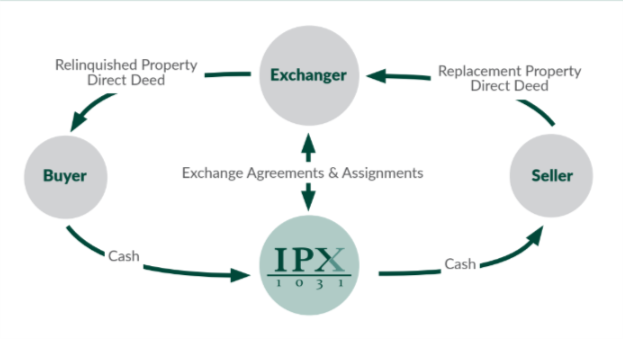
  • Prior to closing the sale of the Relinquished Property the Exchanger and a Qualified Intermediary must enter into an Exchange Agreement which requires the Qualified Intermediary to
    • acquire the Relinquished Property from the Exchanger and transfer it to the buyer (by direct deed from Exchanger to buyer)
    • acquire the Replacement Property from the seller and transfer it to the Exchanger (by direct deed from seller to Exchanger).
  • Also prior to closing the sale of the Relinquished Property, the Exchanger must assign rights under the Relinquished Property sale contract to the Qualified Intermediary and provide notice of assignment to the buyer.
  • At closing, net proceeds from the Relinquished Property sale (exchange funds) are paid directly to the Intermediary to be held in a separate account for the Exchanger until used to purchase Replacement Property.

From here, the Exchanger now has the responsibility to find a suitable exchange property.  They are given 45 days after escrow closes to identify property, with the possibility of a 21 day post-escrow window and a further possibility to appeal for a 15 day extension; this sums up to a total possible 81 days to identify property which should allow for plenty of time for the Exchanger to decide.


There are 3 main rules to identifying one or more properties to acquire in the exchange which are as follows:

  • The 3 property rule- the maximum number of properties that can be acquired under normal circumstances is 3.
  • The 200% rule- the aggregate value of the properties can not exceed 200% of the selling value of the property that had initially been exchanged (again also under normal circumstances). 
  • The final rule is called the 95% rule and really only exists as an exception to the first two rules and is extremely uncommon.  What it does is allows for more than 3 properties worth up to and exceeding 200% of the original’s selling value to be purchased in the exchange provided that the Exchanger acquires 95% of the total sum value of the identified properties within the exchange period.  This effectively never happens in practice and the rule can almost essentially be ignored.
  • Once the property has been identified, there is a 135 day period during which the property is to be purchased and the Exchange comes to a close.


Now that we know what a 1031 Exchange is, it’s time to cover our second big answer to our question…

What is a DST, and why do I want one?

  • Simply put, a deferred sales trust is a financial vehicle that allows investors to transfer highly appreciated assets to a trust for the purpose of deferring payment of capital gains taxes and generating an income stream. These trusts are an alternative to 1031 exchanges and direct sales and can protect your assets from being too highly taxed.
  • A DST is a contractual arrangement between an individual and a trust in which the individual sells property to the trust in exchange for the trust’s agreement to pay the individual a certain amount over an agreed period of time.
  • Deferred Sales Trusts are completely legal as they have been reviewed by the IRS, FINRA, as well as National Tax Law Firms
  • 1031 timelines and restrictions make it difficult to find a quality deal, especially combined with the lack of inventory to choose from.
  • Interest rates in the US are hovering near 40 year lows.
  • Investors can allocate more funds to their portfolio than what would result from a direct sale.
  • DSTs can be used to invest back into real estate or a business, .  As long as the money stays in the trust and does not go directly back to you without first going through the trust, you can do virtually anything with it.

Process of a Deferred Sales Trust:

  • Go to MyDSTPlan.com and get in contact with the Estate Planning Team.  The EPT is a group of legal and financial service professionals dedicated to helping preserve wealth and protect estate.  Deferred Sales Trusts are exclusively offered by the EPT along with a handful of specialized tax attorneys with unique experience. 
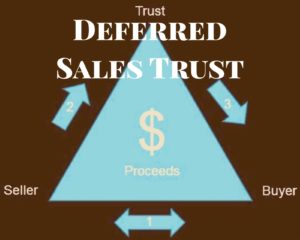
  • Assets to sell are sold to a third party trustee in consideration of a secured DST installment contract
  • The third party DST trustee buys the assets, who sells them to a cash buyer
  • The cash buyer pays to the trust in exchange for the assets
  • The secured DST installment payments are made to the seller from the trust
  • DST payout timeline: the trust is written in 10 year increments traditionally up to 30 years, but can be extended out 10 years at a time indefinitely; meaning that the payout can be extended to 40, 50, or more years as long as you are willing to adjust the payout to fit the newly adjusted timeline.

FAQ:

  • Is there a fee for the DST?  Generally speaking it will be 1.5% to write the trust, and a trust deed fee, 25 to 50 point basis fee, 1% advisory fee, and small management fees.
  • Can two parties join in a 1031 together to buy a new property together?  Yes, both parties can be involved in a 1031 and do it so long as they keep the same taxpayer and make tenants in common.
  • What happens if you are involved in a reverse exchange?  The buyer cannot have both properties in your name at the same time so the 1031 exchange company creates an LLC to buy the property, buyer loans money to buy the house, do a NNN lease agreement, then do a proper 1031 exchange if the property closes.
  • What is a NNN lease agreement?  It is an agreement that the lessee is to take care of all repairs and renovations to the property being leased.  Many major companies go into NNN leases when they have chain stores such as Home Depot or McDonalds.


Click here to go back to the top

Click here to go to 1031 Exchange

Click here to jump to Deferred Sales Trusts

Meeting w Masters Returns

     In this upcoming session of Meeting with the Masters we have Greg Burns of IPX1031, Tom Bernath of Ticor Title, and Joel Harworth from 1 on 1 Financial here to discuss the ins and outs of 1031 Exchanges and Deferred Sales Trusts and how to use them to your advantage.   In June, we talked about all of the intricacies of probate, and before that we covered bankruptcy, real estate transactions, and divorce.  Well, in this month’s Meeting you’ll want to be there and sit in on our conversation as long as you’re one of the following:
  • You want to know more about growing your business with investors
  • Either are or know someone with multiple properties to manage
  • Want to learn more about deferring capital gains
  • Or just really like us!

We host our Masters series because we want to help raise awareness to the quirks of the fickle mistress that is the title industry, you won’t want to miss a thing.

We hope that you can make the time to come out to the Red Hill Country Club on August 14th at 10 am and look forward to seeing you there!  The link to the event page can be found HERE.
Here is a video overview of one of our previous classes!

Subscribe to our PODCASTS!!!

No matter what platform you choose to use, we have the most common listed here.

When you listen, please give us feedback.. Comment and or share!

iTunes

Click Here

Stitcher

Click Here

Spotify 

Click Here

BE Aware, Phone Scammers… #KnowledgeIsPower

A new phone scam has been popping up recently, but with a strange new twist — your own number is calling you. Scammers are using this new tactic to phish for your personal information. Hundreds of residents in Central Valley, California, have reported receiving this scam phone call.

The “robodialer” dials and once the phone is answered, a person takes over on the other end asking them for personal information, like the last four digits of their Social Security number. The caller threatens that their AT&T® accounts have been compromised or will be closed, and that they must enter the last four digits of the account holder’s Social Security number for verification to keep it active.

In another variation, the scammer asks for information pertaining to setting up their voicemail account. No matter what variation of the call you receive, scammers are only after one thing — your personal information. This information can potentially help them hack your accounts or steal your identity.

The Better Business Bureau® (BBB) offers up the following tips to protect you from becoming victim to the next phone scam:

  • Do not trust caller ID
    Victims fall for phone scams because they assume the number on their caller ID is the correct person. Scammers can easily spoof numbers to make it look like a certain person is calling you, when in reality they are not.
  • Do not give out personal information
    Any legitimate person or business who reaches out to you will already have your information on hand. If they do not, or if you receive a call out of the blue asking for your personal information just hang up.
  • Scammers usually pose as a trusted source
    Scammers usually pose as a trusted source to get any information they can out of you. If you hang up immediately on them, they will not be able to phish for that information.
  • Do not press buttons
    Many “robocallers” will prompt you to “press 9” to be taken off their call list. This will only do the opposite and flood your phone with even more calls. Pressing a number on the keypad alerts them that they have reached an active number.
  • Beware of big name companies calling
    Scammers impersonate big name companies, charities and legitimate businesses, hoping that you will be more inclined to give up your personal information to them. If you receive such a call hang up immediately, find the appropriate number on your own and call the business to verify.
  • Sign up for the Do Not Call Registry
    To cut down on the amount of calls you receive, you can register your phone number for free through the Federal Trade Commission (FTC) Do Not Call Registry. The Do Not Call Registry prohibits sales calls, so you may still receive political calls, charitable calls, debt collection calls, informational calls, telephone survey calls and calls from companies you have recently done business with.
  • Do not answer
    If you receive a phone call from a number you are unsure of, it is best to just let it go to voicemail. Any legitimate person or business will leave a message, but even if the scammer decides to leave you a voicemail, you will have time to think about what is being asked by them, instead of being pressured on the spot to give up your personal information.

If you receive a scam phone call, report it to BBB Scam Tracker at www.bbb.org/scamtracker or the FCC at www.fcc.gov.

-Source FNF Fraud Insights..

Meet Lori, Customer Service Extraordinaire!

Its all about the people!

When it comes down to differentiating companies, it truly comes down to the people and the service they give.

Over the years I have found that the really good ones become like family. Lori truly rocks! Watch this video and get to know her a little better, and how to use best practices to get what you need and more importantly WHEN you need it!

Common Requests:

  • Farms
  • Labels
  • Profiles
  • Tax Roles
  • Zoning
  • Permits
  • Investor Searches

You always have options when working with us, be it the personal touch, or tools like www.TicorOnline.com & mobile app Ticor Elite to request your data.

To get your accounts dialed in, or a refresher on the tools, reach out today!

  • Page 1
  • Page 2
  • Page 3
  • Go to Next Page »

Footer

Follow Us

Yelp Reviews

Fidelity National Title
4.6
Based on 21 Reviews
Yelp logo
Cody M.
Cody M.
2025-05-04 08:35:26
Ryan and the team at National Title are professional, efficient, and a pleasure to work with. Highly recommend this 5 star business! read more
Jimmie H.
Jimmie H.
2022-12-03 18:14:01
Ryan Orr is no longer at Stewart Title. The Stewart Office in Ontario is close. If you need Stewart Title please call Jimmie Herrick 9095449407. I have been... read more
Shereece M.
Shereece M.
2022-04-21 16:09:47
Ryan Orr is an amazing Title Representative!! I've been utilizing his services for well over 10 years! Not only is he professional, he's a person of... read more
Erick B.
Erick B.
2022-01-20 17:20:32
Ryan O. gets the job done! Take my word for it and contact him for all of your title needs! read more
Jerrico C.
Jerrico C.
2020-12-23 18:23:52
Common theme with this company seems to be that they help customers knowing fully well that they may not be part of a transaction. Ryan answered some... read more
Scott C.
Scott C.
2019-07-27 07:28:04
Thank you Ryan for going out of your way to help out on a challenging escrow this past Saturday. I was on Catalina for our week long Boy Scout camp and had... read more
Cecilia L.
Cecilia L.
2019-07-20 12:51:19
The worst escrow company to deal with in the USA. Worst customer service. The escrow and Title charges and fees are up to the heaven and as tall as the flag... read more

Copyright © 2026 · Ryan J. Orr · Fidelity National Title
Privacy | California Privacy | Terms of Use | Accessibility