• Skip to primary navigation
  • Skip to main content
  • Skip to footer
  • Home
  • About Team Title Guy
  • Book Appointment
  • Subscribe to Email
  • Contact me
Team Title Guy

Team Title Guy

Sell... Buy... Refi... Specify Team Title Guy!

  • YouTube Videos
    • YouTube Channel
    • Educational Minute
    • Ryan’s Rants
    • TTG Events
    • Rancho Cucamonga
    • Training Classes
    • City Programs
    • Real Estate Closings
  • Event Calendar
  • Market Update
  • Blog
  • Reviews
    • Yelp Reviews
  • Title Resources
    • Forms and Documents
    • Informational Flyers
    • Transfer Tax and City Tax
    • Legal Documents
    • Fidelity Fee Schedule
    • Order CPL
    • Fidelity Agent
    • FNT Utilities
    • Comps
  • Podcast

Deferred Sales Trust

What even ARE Deferred Sales Trust and 1031 Exchange?

In this session of Meeting with the Masters we have Greg Burns of IPX1031, as well as Joel Harworth and Philip A. Board from 1 on 1 Financial here to discuss the ins and outs of 1031 Exchanges and Deferred Sales Trusts and how to use them to your advantage. If you prefer to listen to the recording of the episode, you can hear it HERE.  As always, you can listen to our podcasts on Itunes, Stitcher, or Spotify.

The Masters Team: Greg Burns, Philip A. Board, Ryan J. Orr, Joel Harworth, and Ron Romero

This discussion is going to be based upon the answers to the question what should you do with appreciated assets you want to cash in on?  The answers to this question are as follows:  Sell and pay the astronomical taxes on them, do a 1031 Exchange, do a Deferred Sales Trust, or just hold onto your assets.  We’ll be discussing everything about the middle two options because the others are self explanatory.

Click here to jump to Deferred Sales Trusts

Click here to jump to FAQ

Why Do a 1031 Exchange & What are the Limitations?:

  • 1031 tax code says that if you sell a property for investment or business use to exchange for another real estate property whose initial intent of purchase must be investment or business use, you can defer the tax.
  • Why is deferring the tax such a big deal?  The tax on a real estate sale is HUGE, at 24.3% as the bare minimum in the state of California.
  • So you want to 1031 exchange for a duplex you rent out in order to buy an “investment property” in Hawaii a few years before you’re ready to retire.  Now you can defer all tax to the sale as long as you have a minimum of 2 weeks of income per year.  If client makes any repairs, it does not count against the two weeks, so people tend to “do repairs” and stay there for a while.
  • Now, say you plan on using this investment property as your retirement property a few years down the line.  The purpose of the exchange is strictly for investment or business use, but after a minimum of about 2 years of use as an investment you have the ability to use it as you please without risking the IRS coming after you about it.
  • 1031 is not a condition of sale, you can notify the buyer, but don’t need to advertise it as the buyer does not have to have anything to do with the exchange.  However, when writing up the contract for the sale you must put in language stating that the seller is doing an exchange and you furthermore must hire a company that does 1031 exchange in house like IPX, they have 45 days after the escrow closes to identify a property to exchange (loophole for that is listed in the process of an exchange section).

Now that we have that out of the way, we can discuss the…

Process of a 1031 Exchange:

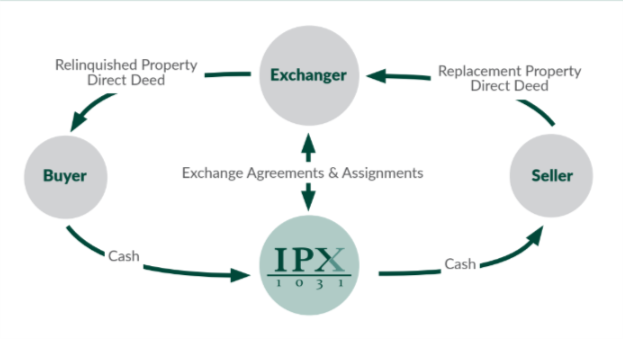
  • Prior to closing the sale of the Relinquished Property the Exchanger and a Qualified Intermediary must enter into an Exchange Agreement which requires the Qualified Intermediary to
    • acquire the Relinquished Property from the Exchanger and transfer it to the buyer (by direct deed from Exchanger to buyer)
    • acquire the Replacement Property from the seller and transfer it to the Exchanger (by direct deed from seller to Exchanger).
  • Also prior to closing the sale of the Relinquished Property, the Exchanger must assign rights under the Relinquished Property sale contract to the Qualified Intermediary and provide notice of assignment to the buyer.
  • At closing, net proceeds from the Relinquished Property sale (exchange funds) are paid directly to the Intermediary to be held in a separate account for the Exchanger until used to purchase Replacement Property.
From here, the Exchanger now has the responsibility to find a suitable exchange property.  They are given 45 days after escrow closes to identify property, with the possibility of a 21 day post-escrow window and a further possibility to appeal for a 15 day extension; this sums up to a total possible 81 days to identify property which should allow for plenty of time for the Exchanger to decide.


There are 3 main rules to identifying one or more properties to acquire in the exchange which are as follows:

  • The 3 property rule- the maximum number of properties that can be acquired under normal circumstances is 3.
  • The 200% rule- the aggregate value of the properties can not exceed 200% of the selling value of the property that had initially been exchanged (again also under normal circumstances). 
  • The final rule is called the 95% rule and really only exists as an exception to the first two rules and is extremely uncommon.  What it does is allows for more than 3 properties worth up to and exceeding 200% of the original’s selling value to be purchased in the exchange provided that the Exchanger acquires 95% of the total sum value of the identified properties within the exchange period.  This effectively never happens in practice and the rule can almost essentially be ignored.
  • Once the property has been identified, there is a 135 day period during which the property is to be purchased and the Exchange comes to a close.


Now that we know what a 1031 Exchange is, it’s time to cover our second big answer to our question…
What is a DST, and why do I want one?

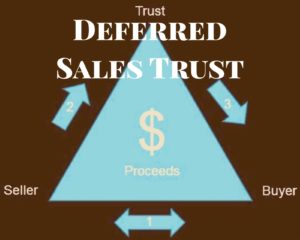
  • Simply put, a deferred sales trust is a financial vehicle that allows investors to transfer highly appreciated assets to a trust for the purpose of deferring payment of capital gains taxes and generating an income stream. These trusts are an alternative to 1031 exchanges and direct sales and can protect your assets from being too highly taxed.
  • A DST is a contractual arrangement between an individual and a trust in which the individual sells property to the trust in exchange for the trust’s agreement to pay the individual a certain amount over an agreed period of time.
  • Deferred Sales Trusts are completely legal as they have been reviewed by the IRS, FINRA, as well as National Tax Law Firms
  • 1031 timelines and restrictions make it difficult to find a quality deal, especially combined with the lack of inventory to choose from.
  • Interest rates in the US are hovering near 40 year lows.
  • Investors can allocate more funds to their portfolio than what would result from a direct sale.
  • DSTs can be used to invest back into real estate or a business, .  As long as the money stays in the trust and does not go directly back to you without first going through the trust, you can do virtually anything with it.

Process of a Deferred Sales Trust:

  • Go to MyDSTPlan.com and get in contact with the Estate Planning Team.  The EPT is a group of legal and financial service professionals dedicated to helping preserve wealth and protect estate.  Deferred Sales Trusts are exclusively offered by the EPT along with a handful of specialized tax attorneys with unique experience. 
  • Assets to sell are sold to a third party trustee in consideration of a secured DST installment contract
  • The third party DST trustee buys the assets, who sells them to a cash buyer
  • The cash buyer pays to the trust in exchange for the assets
  • The secured DST installment payments are made to the seller from the trust
  • DST payout timeline: the trust is written in 10 year increments traditionally up to 30 years, but can be extended out 10 years at a time indefinitely; meaning that the payout can be extended to 40, 50, or more years as long as you are willing to adjust the payout to fit the newly adjusted timeline.

FAQ:

  • Is there a fee for the DST?  Generally speaking it will be 1.5% to write the trust, and a trust deed fee, 25 to 50 point basis fee, 1% advisory fee, and small management fees.
  • Can two parties join in a 1031 together to buy a new property together?  Yes, both parties can be involved in a 1031 and do it so long as they keep the same taxpayer and make tenants in common.
  • What happens if you are involved in a reverse exchange?  The buyer cannot have both properties in your name at the same time so the 1031 exchange company creates an LLC to buy the property, buyer loans money to buy the house, do a NNN lease agreement, then do a proper 1031 exchange if the property closes.
  • What is a NNN lease agreement?  It is an agreement that the lessee is to take care of all repairs and renovations to the property being leased.  Many major companies go into NNN leases when they have chain stores such as Home Depot or McDonalds.


Click here to go back to the top

Click here to go to 1031 Exchange

Click here to jump to Deferred Sales Trusts

Meeting w Masters Returns

     In this upcoming session of Meeting with the Masters we have Greg Burns of IPX1031, Tom Bernath of Ticor Title, and Joel Harworth from 1 on 1 Financial here to discuss the ins and outs of 1031 Exchanges and Deferred Sales Trusts and how to use them to your advantage.   In June, we talked about all of the intricacies of probate, and before that we covered bankruptcy, real estate transactions, and divorce.  Well, in this month’s Meeting you’ll want to be there and sit in on our conversation as long as you’re one of the following:
  • You want to know more about growing your business with investors
  • Either are or know someone with multiple properties to manage
  • Want to learn more about deferring capital gains
  • Or just really like us!

We host our Masters series because we want to help raise awareness to the quirks of the fickle mistress that is the title industry, you won’t want to miss a thing.

We hope that you can make the time to come out to the Red Hill Country Club on August 14th at 10 am and look forward to seeing you there!  The link to the event page can be found HERE.
Here is a video overview of one of our previous classes!

Probate and You: Survival Tips


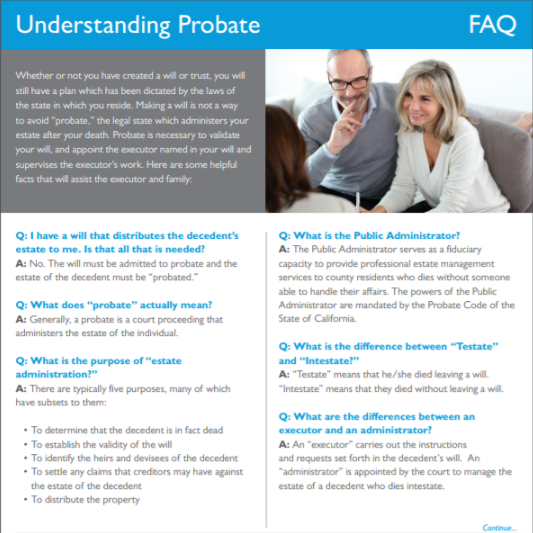
In this session of Meeting with the Masters, we have Masters Tom Bernath and Jason Gaudy detailing the probate process and covering the big mistakes we make when handling a probate.  We’ll break down the biggest points here…

First things first, there are only two ways to avoid a probate altogether: stay alive forever, or not own property when you die.  While this seems impossible, there’s actually a few ways to do this:

  • Joint tenancy allows property to automatically pass to the survivor upon death
  • Community property with right of survivor-ship
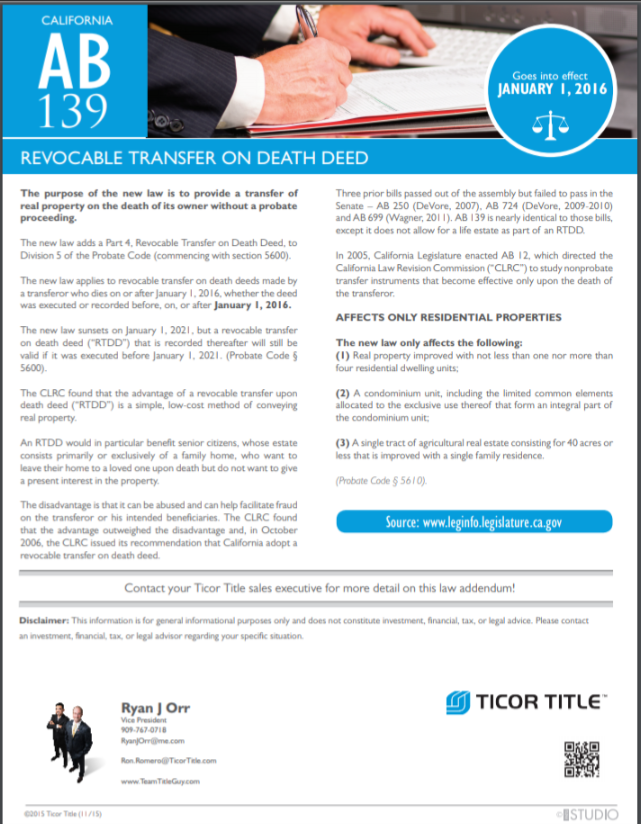
  • Trusts or family partnerships make it so the decedent does not own the property individually, and the successor(s) takes control of the property upon death.  Revocable Transfer on Death deeds are some of the easiest ways around a probate.
  • Revocable Transfer on Death deeds are a simple, inexpensive way to transfer real estate to someone else upon your death. They work similarly to a life insurance policy or a payable on death account at a bank because the asset passes to your named beneficiary upon your death outside the probate system.
    • This is revocable at any point before death and is strongly suggested over an irrevocable transfer should something happen.  RTDDs have come into question as they have been used to quickly avoid a probate on a dying person’s estate.
    • They have led to many of the stories where someone comes in and convinces an elderly person to sign away everything and leave it all to one party out of nowhere.  As such, they are difficult to insure, sometimes difficult to prove the competency of the deed’s signer, and all documentation must be present and in order for it to be permissible.  More information is supplied below as an image.


Now, usually a client will be coming to you because they need a probate and not because they managed to find a way to live forever, so we’re going to cover the steps in a probate:

A potential client steps into your office and either has or does not have a will.  If they have a will, there’s a pretty good chance that an executor has been appointed to manage the estate already.  If not, you’ll have to work together to get an administrator appointed to manage the estate.

From there, we have to get the executor/administrator petitioned and a hearing will be held in a Court to be granted authority;  there are two types of authority in a probate: full authority and limited authority.  Generally, it’s best to just go for full authority.  Full authority gives the Public Administrator (PA) the power to handle the majority of the estate process it does not mean the PA can do anything they wish,they must act in the best interests of the estate and their actions can be subject to examination later on by the court or a beneficiary but they have the authority to sell personal property, stocks, and real estate with little delay.

Despite its namesake, full authority does not mean autonomy or even really mean “full” authority.  What it actually means is that the Public Administrator will have to submit something called a notice of proposed action which gives the beneficiaries a chance to object to an aforementioned action before it goes through if they have reason to believe it is not in best interest of the estate.  Action can only be made if no objections are made within the 15 days.  Limited authority gives no authority, virtually everything must be taken through the court and every step must be followed precisely and court guidance must be followed consistently which makes for a significantly longer and much more painful process.

Once authority has been decided, Letters of Administration are issued by the Court.  Then comes a creditors period where creditors are notified and given 4 months to respond before we can get to the appraisal and inventory.  From there we have the final petition for distribution with the court.  During the petitioning phase, escrow can be opened and the property can start to be sorted out.  We have the hearing next and as soon as that is completed, we can close escrow almost immediately if prepared to.  The whole process generally takes a year assuming there are no major disputes or conflicts with the administrator and beneficiaries.

Important Probate Code Content and Documents:

  • Independent Administration of Estates Act (IAEA) (Probate Code §§10400-10592)- this covers the aspect of full and limited authority, detailing everything from checking the box on probate forms for authority to exactly what a PA can and cannot do with their authority.
  • Real Property of Small Value ($50,000) (P.C. §13200)- Six months have passed since death.  The gross value of real property in the decedent’s estate located in California does not exceed $50,000 (happens rarely, usually with out-of-state residents whose only California real estate is a timeshare or vacant land in a remote location).  A form entitled “Affidavit re Real Property of Small Value”, along with an appraisal must be filed with the Court Clerk, who signs the certificate on the form.
  • Surviving Spouse’s Right to Dispose of Community Property (P.C. §13540)- 40 days have passed since death, the property was community property, the surviving or Administrator must record an affidavit stating that the statutory requirements have been satisfied. This allows the spouse to dispose of community property as they see fit by means of sale, lease, mortgage, etc.  The procedure does not apply if a third party records a notice claiming an interest in the property. (P.C. §13541.)
  • Decree of Final Distribution- A final judgment issued by the probate court that is conclusive as to the rights of the legatees, devisees and all beneficiaries and details their respective shares.

Things to keep in mind:

  • The term “based on the fact pattern” is going to be key.  If something comes into question or becomes an issue, but all procedure so far has been followed carefully and every party has been transparent with information, the court is likely to continue to permit actions.  If it appears that any procedure has been ignored or it seems that some things are being handled below the board, this will slow down the process and increase risk all around.
  • The average cost of a probate proceeding is between 5 and 10 percent.
  • In the state of California it is possible to do an Order Determining Succession to Real Property, which creates a simplified probate proceeding.  The only way to do this is if the gross value of the decedent’s real and personal property does not exceed $100,000 and a probate has not yet been filed.
  • An Affidavit of Death of Surviving Spouse can rarely pass in lieu of a probate
  • Community Property with Right of Survivor-ship is a good option if no trust has been made.  This gives the benefits of community property and joint tenancy, meaning a probate can be avoided and there are additional tax beneficial incentives to do so.  However, as the property is given to the survivor, it is no longer community property upon death and must be managed from there to avoid a probate.  Estate tax exemption is $5,000,000 with a 35% estate tax for any amount over that limit.
  • A court order given in a different state is not valid in the state of California without an ancillary probate.
  • Just because a deed has been recorded does not mean that it cannot be objected or fought.  A deed being recorded simply means that it has been documented properly, not that it is necessarily valid.
  • A deed that is void for any reason such as fraud, undue influence, duress, mistake etc. passes no title.  In such a case, there would
    arguably be no bonafide purchaser.  Therefore, the deed would be void, pass no title, and the property would be subject to the
    return to the estate.
  • Living trusts work similar to a will, and they do not protect you like a corporation will.

Common Mistakes and Things to Avoid:

  • Picking the wrong PA  for a probate is the worst possible mistake to make.  You want to look for someone who is good at peacekeeping.  Choosing the wrong Administrator can make every single step of the probate more difficult as there may be constant dispute and therefore delay even with full authority.
  • Talk your client out of doing a probate loan.  It just isn’t worth it.
  • Never, ever use an irrevocable living trust.  All it does is make sure that nothing can be fixed if something were to happen with the appointed trustee(s).
  • Avoid a short sale probate, and furthermore there should ideally be greater than $50,000 in total equity  involved.
  • If a property is in foreclosure, your time very limited if there is a trust deed sale date already, proceed with caution on these.


FAQ:


Footer

Follow Us

Yelp Reviews

Fidelity National Title
4.6
Based on 21 Reviews
Yelp logo
Cody M.
Cody M.
2025-05-04 08:35:26
Ryan and the team at National Title are professional, efficient, and a pleasure to work with. Highly recommend this 5 star business! read more
Jimmie H.
Jimmie H.
2022-12-03 18:14:01
Ryan Orr is no longer at Stewart Title. The Stewart Office in Ontario is close. If you need Stewart Title please call Jimmie Herrick 9095449407. I have been... read more
Shereece M.
Shereece M.
2022-04-21 16:09:47
Ryan Orr is an amazing Title Representative!! I've been utilizing his services for well over 10 years! Not only is he professional, he's a person of... read more
Erick B.
Erick B.
2022-01-20 17:20:32
Ryan O. gets the job done! Take my word for it and contact him for all of your title needs! read more
Jerrico C.
Jerrico C.
2020-12-23 18:23:52
Common theme with this company seems to be that they help customers knowing fully well that they may not be part of a transaction. Ryan answered some... read more
Scott C.
Scott C.
2019-07-27 07:28:04
Thank you Ryan for going out of your way to help out on a challenging escrow this past Saturday. I was on Catalina for our week long Boy Scout camp and had... read more
Cecilia L.
Cecilia L.
2019-07-20 12:51:19
The worst escrow company to deal with in the USA. Worst customer service. The escrow and Title charges and fees are up to the heaven and as tall as the flag... read more

Copyright © 2026 · Ryan J. Orr · Fidelity National Title
Privacy | California Privacy | Terms of Use | Accessibility