
• Skip to primary navigation
  • Skip to main content
  • Skip to footer
  • Home
  • About Team Title Guy
  • Book Appointment
  • Subscribe to Email
  • Contact me
Team Title Guy

Team Title Guy

Sell... Buy... Refi... Specify Team Title Guy!

  • YouTube Videos
    • YouTube Channel
    • Educational Minute
    • Ryan’s Rants
    • TTG Events
    • Rancho Cucamonga
    • Training Classes
    • City Programs
    • Real Estate Closings
  • Event Calendar
  • Market Update
  • Blog
  • Reviews
    • Yelp Reviews
  • Title Resources
    • Forms and Documents
    • Informational Flyers
    • Transfer Tax and City Tax
    • Legal Documents
    • Fidelity Fee Schedule
    • Order CPL
    • Fidelity Agent
    • FNT Utilities
    • Comps
  • Podcast

Blog

BE Aware, Early Wire Discount Fraud

Vivienne, a first time home buyer, was involved in the purchase of a $1.8 million home. The transaction was getting ready to close. She received an email from what appeared to be her settlement agent’s assistant, but in reality the message was generated from a fraudulent email account. The message read as follows:

Hi Vivienne,
Congratulations on your real estate purchase. This is just a friendly reminder that we are scheduled for closing Friday June 1st. I will be the escrow closer handling this transaction. Find attached Settlement Statement and our Wiring Instruction for outstanding balance of your down payment, amount due is $753,252.73.However, we will give you a 20% off Escrow fee (a total of $500 off) if wire can be initiated earlier, due to our current workload as we pride our–self in client satisfaction and the ease at which we conduct our business, It is advisable that wire be initiated Earlier to the attached bank wiring Instructions as this will guarantee that funds are available for disbursement at your scheduled closing, if yes amount due will be $752,752.73Kindly confirm that you have received Wiring instruction attached and advise if wire can be initiated today you can reply to this email if you have any questions or call or text me on my direct line 615 392 5075 looking forward to a successful close.

Vivienne called the number and heard a voice recording saying the escrow officer’s assistant’s name, but the voice sounded foreign and robotic. Vivienne was suspicious the email was not truly originating from her escrow officer’s assistant and that the voice phone number was not truly dialing Chicago Title Company.

Vivienne promptly forwarded the email to her real estate agent. The real estate agent called the escrow officer using a known, trusted number and confirmed the home buyer’s suspicions, the email was fraudulent. Fortunately for all involved the homebuyer did not fall for the scam and the transaction was able to successfully close on time.

How It Works

A scammer typically gains access to a transactional participant’s email account. With access to the real email account, the scammer can observe email exchanges and create fake emails that look authentic, including email signatures and company logos, of various transactional participants. Using these authentic looking email, the scammer is able to impersonate anyone involved in the transaction and send fraudulent wire instructions to the consumer, diverting their money to a fraudster’s account.

5 Warning Signs To Watch For

  • Make a decision now!
    Rushing someone to make a financial commitment may be more than an irresponsible business practice — it could be a sign of fraud. A wire transfer of funds should never occur until the consumer has time to verify the bank wire information with trusted resources.
  • Change in wire instructions
    Consumers likely are the target of a real estate scam if the settlement agent or title company informs them previous wire transfer instructions were incorrect or changed, and they provide new instructions. Settlement agents and title companies rarely change their bank accounts.
  • Discounts for sending a wire transfer
    The processing of a wire transfer costs the sender and recipient, fees and costs. Settlement agents do not offer discounts for consumers depositing their down payment and closing costs via wire transfer.
  • Does the message make sense?
    Most fraudsters perpetrating the crime do not speak English as their first language. Their messages contain misuse of grammar, spelling and punctuation. Often times, the message does not make complete sense.
  • Account Name = Settlement Agent/Title Company
    The account name on the wire instructions often contains the name of an unknown individual or company, and not the name of the settlement agent or title company. In some cases the account name has portions of the settlement agent name combined with an individual’s name. If the account name is not an exact match, the wire instructions are not accurate. That said, the account name in the wire instructions is not the only thing that should be relied upon.

A wire transfer is an immediate form of payment. It is sometimes irreversible, even if fraud is involved. If a consumer falls prey to the diverted wire transfer scam, not only could they lose the money they transferred, but they would still need to provide the funds required to close on their property purchase.

Real estate professionals should communicate to consumers that they need to call to verify the wire transfer with a known, trusted source at the settlement agent or title company who can identify the details of the specific transaction, as well as verify the bank wiring information.

Consumers should be warned not to send any money without talking to a live person with details only the settlement agent would know and a complete verification of the wire information.

In addition, consumers should never use the phone number provided in the email containing the instructions, they should use phone numbers they have called before or can otherwise verify. And, they should never send an email to verify, as the email address may be incorrect or the email may be intercepted by the fraudsters.


(2018, July). Discount for early wire. Retrieved from: http://fraudinsights.fnf.com/vol13iss07/article1.htm

Introducing the ALL NEW TicorAgent ONE

Team Title Guy is proud to announce a brand new version of our app, to be released on July 18th.  TicorAgent has been completely rebuilt from the ground up as the next logical progression for the tool you all know and love!  That’s right, we’ve spent the last two years working on a full revamp of Real Estate’s #1 closing cost app and slated a release date for July 18th.

In case you didn’t know what exactly it is TicorAgent does, the short answer is… everything you could possibly want in a closing app!  It has all the calculators you could need: monthly affordability, price difference between renting and buying, a Refi calculation tool, how extra payments will change any other calculations, loan balance, and even more calculators all for free.  You can use the TA ONE app on up to five devices, it offers geography specific reports, quick text features, all kinds of payment information, and the list just goes on.  Stay tuned for an upcoming in-depth guide on how to use this powerful tool in the near future!

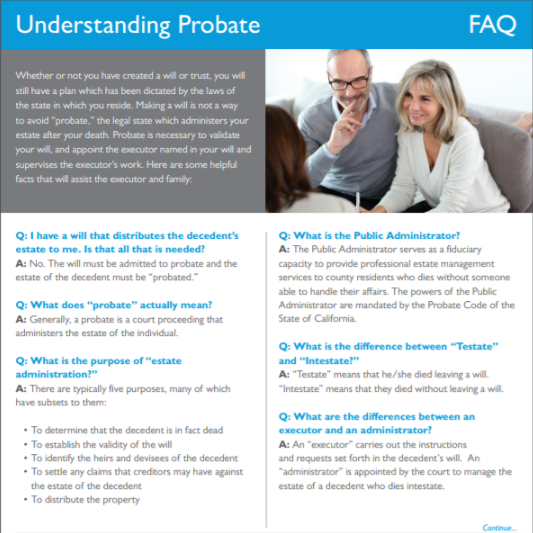
Probate and You: Survival Tips


In this session of Meeting with the Masters, we have Masters Tom Bernath and Jason Gaudy detailing the probate process and covering the big mistakes we make when handling a probate.  We’ll break down the biggest points here…

First things first, there are only two ways to avoid a probate altogether: stay alive forever, or not own property when you die.  While this seems impossible, there’s actually a few ways to do this:

  • Joint tenancy allows property to automatically pass to the survivor upon death
  • Community property with right of survivor-ship
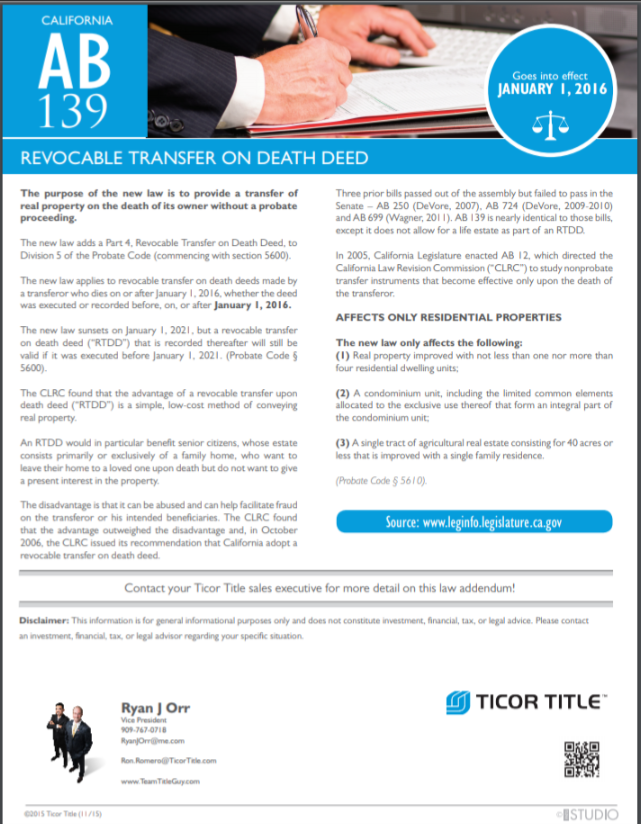
  • Trusts or family partnerships make it so the decedent does not own the property individually, and the successor(s) takes control of the property upon death.  Revocable Transfer on Death deeds are some of the easiest ways around a probate.
  • Revocable Transfer on Death deeds are a simple, inexpensive way to transfer real estate to someone else upon your death. They work similarly to a life insurance policy or a payable on death account at a bank because the asset passes to your named beneficiary upon your death outside the probate system.
    • This is revocable at any point before death and is strongly suggested over an irrevocable transfer should something happen.  RTDDs have come into question as they have been used to quickly avoid a probate on a dying person’s estate.
    • They have led to many of the stories where someone comes in and convinces an elderly person to sign away everything and leave it all to one party out of nowhere.  As such, they are difficult to insure, sometimes difficult to prove the competency of the deed’s signer, and all documentation must be present and in order for it to be permissible.  More information is supplied below as an image.


Now, usually a client will be coming to you because they need a probate and not because they managed to find a way to live forever, so we’re going to cover the steps in a probate:

A potential client steps into your office and either has or does not have a will.  If they have a will, there’s a pretty good chance that an executor has been appointed to manage the estate already.  If not, you’ll have to work together to get an administrator appointed to manage the estate.

From there, we have to get the executor/administrator petitioned and a hearing will be held in a Court to be granted authority;  there are two types of authority in a probate: full authority and limited authority.  Generally, it’s best to just go for full authority.  Full authority gives the Public Administrator (PA) the power to handle the majority of the estate process it does not mean the PA can do anything they wish,they must act in the best interests of the estate and their actions can be subject to examination later on by the court or a beneficiary but they have the authority to sell personal property, stocks, and real estate with little delay.

Despite its namesake, full authority does not mean autonomy or even really mean “full” authority.  What it actually means is that the Public Administrator will have to submit something called a notice of proposed action which gives the beneficiaries a chance to object to an aforementioned action before it goes through if they have reason to believe it is not in best interest of the estate.  Action can only be made if no objections are made within the 15 days.  Limited authority gives no authority, virtually everything must be taken through the court and every step must be followed precisely and court guidance must be followed consistently which makes for a significantly longer and much more painful process.

Once authority has been decided, Letters of Administration are issued by the Court.  Then comes a creditors period where creditors are notified and given 4 months to respond before we can get to the appraisal and inventory.  From there we have the final petition for distribution with the court.  During the petitioning phase, escrow can be opened and the property can start to be sorted out.  We have the hearing next and as soon as that is completed, we can close escrow almost immediately if prepared to.  The whole process generally takes a year assuming there are no major disputes or conflicts with the administrator and beneficiaries.

Important Probate Code Content and Documents:

  • Independent Administration of Estates Act (IAEA) (Probate Code §§10400-10592)- this covers the aspect of full and limited authority, detailing everything from checking the box on probate forms for authority to exactly what a PA can and cannot do with their authority.
  • Real Property of Small Value ($50,000) (P.C. §13200)- Six months have passed since death.  The gross value of real property in the decedent’s estate located in California does not exceed $50,000 (happens rarely, usually with out-of-state residents whose only California real estate is a timeshare or vacant land in a remote location).  A form entitled “Affidavit re Real Property of Small Value”, along with an appraisal must be filed with the Court Clerk, who signs the certificate on the form.
  • Surviving Spouse’s Right to Dispose of Community Property (P.C. §13540)- 40 days have passed since death, the property was community property, the surviving or Administrator must record an affidavit stating that the statutory requirements have been satisfied. This allows the spouse to dispose of community property as they see fit by means of sale, lease, mortgage, etc.  The procedure does not apply if a third party records a notice claiming an interest in the property. (P.C. §13541.)
  • Decree of Final Distribution- A final judgment issued by the probate court that is conclusive as to the rights of the legatees, devisees and all beneficiaries and details their respective shares.

Things to keep in mind:

  • The term “based on the fact pattern” is going to be key.  If something comes into question or becomes an issue, but all procedure so far has been followed carefully and every party has been transparent with information, the court is likely to continue to permit actions.  If it appears that any procedure has been ignored or it seems that some things are being handled below the board, this will slow down the process and increase risk all around.
  • The average cost of a probate proceeding is between 5 and 10 percent.
  • In the state of California it is possible to do an Order Determining Succession to Real Property, which creates a simplified probate proceeding.  The only way to do this is if the gross value of the decedent’s real and personal property does not exceed $100,000 and a probate has not yet been filed.
  • An Affidavit of Death of Surviving Spouse can rarely pass in lieu of a probate
  • Community Property with Right of Survivor-ship is a good option if no trust has been made.  This gives the benefits of community property and joint tenancy, meaning a probate can be avoided and there are additional tax beneficial incentives to do so.  However, as the property is given to the survivor, it is no longer community property upon death and must be managed from there to avoid a probate.  Estate tax exemption is $5,000,000 with a 35% estate tax for any amount over that limit.
  • A court order given in a different state is not valid in the state of California without an ancillary probate.
  • Just because a deed has been recorded does not mean that it cannot be objected or fought.  A deed being recorded simply means that it has been documented properly, not that it is necessarily valid.
  • A deed that is void for any reason such as fraud, undue influence, duress, mistake etc. passes no title.  In such a case, there would
    arguably be no bonafide purchaser.  Therefore, the deed would be void, pass no title, and the property would be subject to the
    return to the estate.
  • Living trusts work similar to a will, and they do not protect you like a corporation will.

Common Mistakes and Things to Avoid:

  • Picking the wrong PA  for a probate is the worst possible mistake to make.  You want to look for someone who is good at peacekeeping.  Choosing the wrong Administrator can make every single step of the probate more difficult as there may be constant dispute and therefore delay even with full authority.
  • Talk your client out of doing a probate loan.  It just isn’t worth it.
  • Never, ever use an irrevocable living trust.  All it does is make sure that nothing can be fixed if something were to happen with the appointed trustee(s).
  • Avoid a short sale probate, and furthermore there should ideally be greater than $50,000 in total equity  involved.
  • If a property is in foreclosure, your time very limited if there is a trust deed sale date already, proceed with caution on these.


FAQ:


Subscribe to our PODCASTS!!!

No matter what platform you choose to use, we have the most common listed here.

When you listen, please give us feedback.. Comment and or share!

iTunes

Click Here

Stitcher

Click Here

Spotify 

Click Here

BE Aware, Phone Scammers… #KnowledgeIsPower

A new phone scam has been popping up recently, but with a strange new twist — your own number is calling you. Scammers are using this new tactic to phish for your personal information. Hundreds of residents in Central Valley, California, have reported receiving this scam phone call.

The “robodialer” dials and once the phone is answered, a person takes over on the other end asking them for personal information, like the last four digits of their Social Security number. The caller threatens that their AT&T® accounts have been compromised or will be closed, and that they must enter the last four digits of the account holder’s Social Security number for verification to keep it active.

In another variation, the scammer asks for information pertaining to setting up their voicemail account. No matter what variation of the call you receive, scammers are only after one thing — your personal information. This information can potentially help them hack your accounts or steal your identity.

The Better Business Bureau® (BBB) offers up the following tips to protect you from becoming victim to the next phone scam:

  • Do not trust caller ID
    Victims fall for phone scams because they assume the number on their caller ID is the correct person. Scammers can easily spoof numbers to make it look like a certain person is calling you, when in reality they are not.
  • Do not give out personal information
    Any legitimate person or business who reaches out to you will already have your information on hand. If they do not, or if you receive a call out of the blue asking for your personal information just hang up.
  • Scammers usually pose as a trusted source
    Scammers usually pose as a trusted source to get any information they can out of you. If you hang up immediately on them, they will not be able to phish for that information.
  • Do not press buttons
    Many “robocallers” will prompt you to “press 9” to be taken off their call list. This will only do the opposite and flood your phone with even more calls. Pressing a number on the keypad alerts them that they have reached an active number.
  • Beware of big name companies calling
    Scammers impersonate big name companies, charities and legitimate businesses, hoping that you will be more inclined to give up your personal information to them. If you receive such a call hang up immediately, find the appropriate number on your own and call the business to verify.
  • Sign up for the Do Not Call Registry
    To cut down on the amount of calls you receive, you can register your phone number for free through the Federal Trade Commission (FTC) Do Not Call Registry. The Do Not Call Registry prohibits sales calls, so you may still receive political calls, charitable calls, debt collection calls, informational calls, telephone survey calls and calls from companies you have recently done business with.
  • Do not answer
    If you receive a phone call from a number you are unsure of, it is best to just let it go to voicemail. Any legitimate person or business will leave a message, but even if the scammer decides to leave you a voicemail, you will have time to think about what is being asked by them, instead of being pressured on the spot to give up your personal information.

If you receive a scam phone call, report it to BBB Scam Tracker at www.bbb.org/scamtracker or the FCC at www.fcc.gov.

-Source FNF Fraud Insights..

BK & RE Transaction- Meetings w Masters TTG Edition

Meeting With Masters

On Feb 15th we were able to continue on in our series on Meeting with Masters at Red Hill Country Club. In this conversation we broke down the nuiances of Ch 7 & 13 and how it impacts your tranasction, and your Clients.

Key Points

  • Timelines
  • Implications
  • Ch 7
  • Ch 13
  • Order of Avoidance
  • Title Implications
  • How to work through BK
  • Foreclosure Implications

We recorded the event and have made it available as a podcast which is available in

iTunes

Click Here

Stitcher

Click Here

Spotify 

Click Here

Guest Speakers: 

Tom Bernath– Advisory Title Officer Ticor Title

Derek May– Bankruptcy Attorney

Host: Ryan J Orr- VP Ticor Title

On the podcasts, we did a similar event with a different attorney, so if you are BK student, you can feel free to check them both out and compare.

My team and I truly believe in being a resource! Lean on us!

  • « Go to Previous Page
  • Page 1
  • Interim pages omitted …
  • Page 13
  • Page 14
  • Page 15
  • Page 16
  • Page 17
  • Interim pages omitted …
  • Page 59
  • Go to Next Page »

Footer

Follow Us

Yelp Reviews

Fidelity National Title
4.6
Based on 21 Reviews
Yelp logo
Cody M.
Cody M.
2025-05-04 08:35:26
Ryan and the team at National Title are professional, efficient, and a pleasure to work with. Highly recommend this 5 star business! read more
Jimmie H.
Jimmie H.
2022-12-03 18:14:01
Ryan Orr is no longer at Stewart Title. The Stewart Office in Ontario is close. If you need Stewart Title please call Jimmie Herrick 9095449407. I have been... read more
Shereece M.
Shereece M.
2022-04-21 16:09:47
Ryan Orr is an amazing Title Representative!! I've been utilizing his services for well over 10 years! Not only is he professional, he's a person of... read more
Erick B.
Erick B.
2022-01-20 17:20:32
Ryan O. gets the job done! Take my word for it and contact him for all of your title needs! read more
Jerrico C.
Jerrico C.
2020-12-23 18:23:52
Common theme with this company seems to be that they help customers knowing fully well that they may not be part of a transaction. Ryan answered some... read more
Scott C.
Scott C.
2019-07-27 07:28:04
Thank you Ryan for going out of your way to help out on a challenging escrow this past Saturday. I was on Catalina for our week long Boy Scout camp and had... read more
Cecilia L.
Cecilia L.
2019-07-20 12:51:19
The worst escrow company to deal with in the USA. Worst customer service. The escrow and Title charges and fees are up to the heaven and as tall as the flag... read more

Copyright © 2026 · Ryan J. Orr · Fidelity National Title
Privacy | California Privacy | Terms of Use | Accessibility